When you pick up a bottle of gin at the store, you might not think twice about what’s inside. But between Tanqueray and Hendrick’s, there’s a world of difference-not just in taste, but in philosophy, history, and how they behave in your glass.
Tanqueray: The Classic Gin Backbone
Tanqueray London Dry Gin isn’t just another gin. It’s one of the most recognizable names in the category, built on a recipe that’s been around since 1830. It’s a Tanqueray is a traditional London Dry gin with a high-proof, juniper-forward profile designed for bold cocktails. What does that mean? It means when you smell it, you get a punch of piney juniper, sharp citrus peel, and a hint of spice-like coriander and angelica root. No frills. No flowers. No cucumber.
Tanqueray is bottled at 94.6 proof (47.3% ABV) in the U.S., which gives it a strong, warming presence. That high alcohol content isn’t an accident-it’s meant to stand up to other strong ingredients. In a Negroni, for example, Tanqueray doesn’t back down. It holds its own against Campari and sweet vermouth. That’s why bartenders who make classic cocktails rely on it. It’s the workhorse.
But here’s the thing: Tanqueray doesn’t always play nice in a gin and tonic. Some tasters describe its flavor as woody, almost like furniture polish, with a bitter finish that lingers. One professional reviewer outright said they wouldn’t use it in a G&T. That’s not a flaw-it’s a design choice. Tanqueray isn’t trying to be easy. It’s trying to be authentic. If you grew up with gin that tasted like pine trees and citrus rind, this is your gin.
Hendrick’s: The Oddball That Changed the Game
Hendrick’s, on the other hand, was created in 1999 and immediately turned heads. It doesn’t follow the rules. In fact, it breaks them. For one, it’s not a London Dry gin-even though it uses juniper, rose petals, and cucumber. Why? Because those last two are added after distillation. London Dry rules say all botanicals must be vapor-infused during distillation. Hendrick’s doesn’t care. And that’s why it’s so popular.
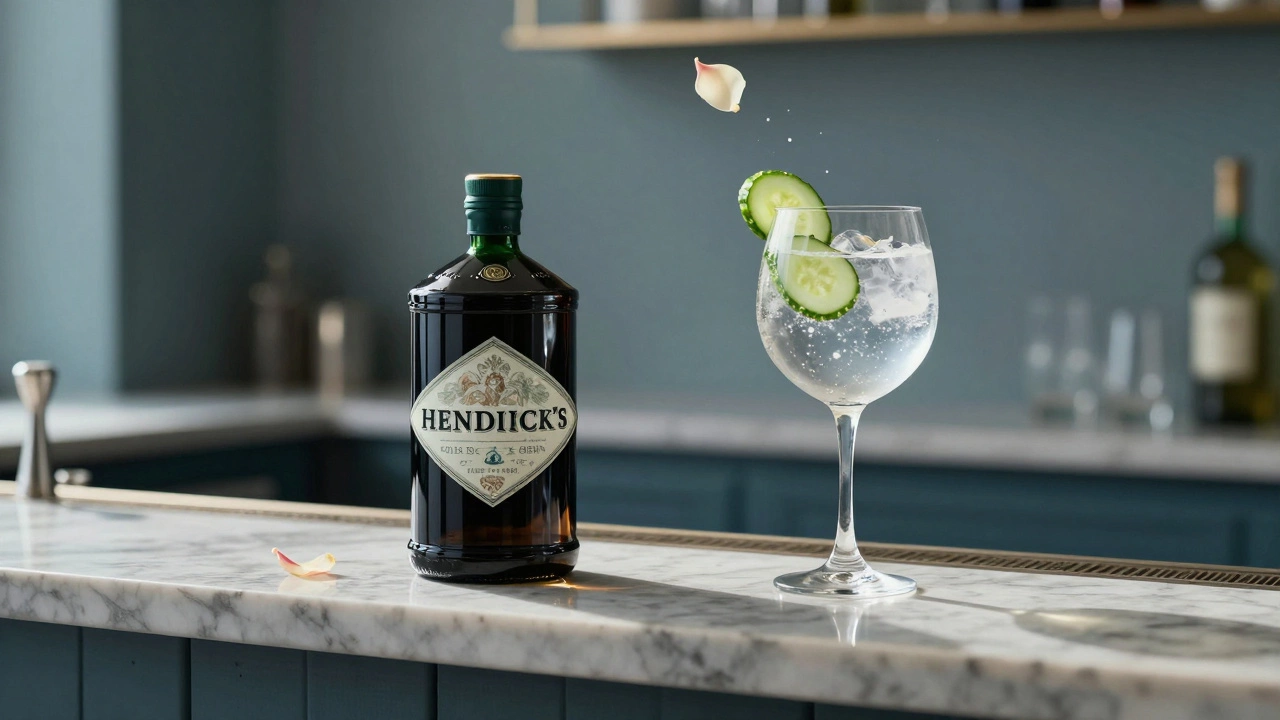
Hendrick’s is a non-traditional gin featuring post-distillation infusion of cucumber and rose petals, creating a floral, refreshing profile ideal for light cocktails. It’s bottled at 82.8 proof (41.4% ABV), which sounds mild-but don’t be fooled. The nose hits you with a surprising heat, almost like a shot of hot sauce. Then, the flavor unfolds: lemon rind, dried herbs, a whisper of rose, and that unmistakable cucumber note. It’s not sweet, but it’s soft. Almost like drinking chilled herbal water with a kick.
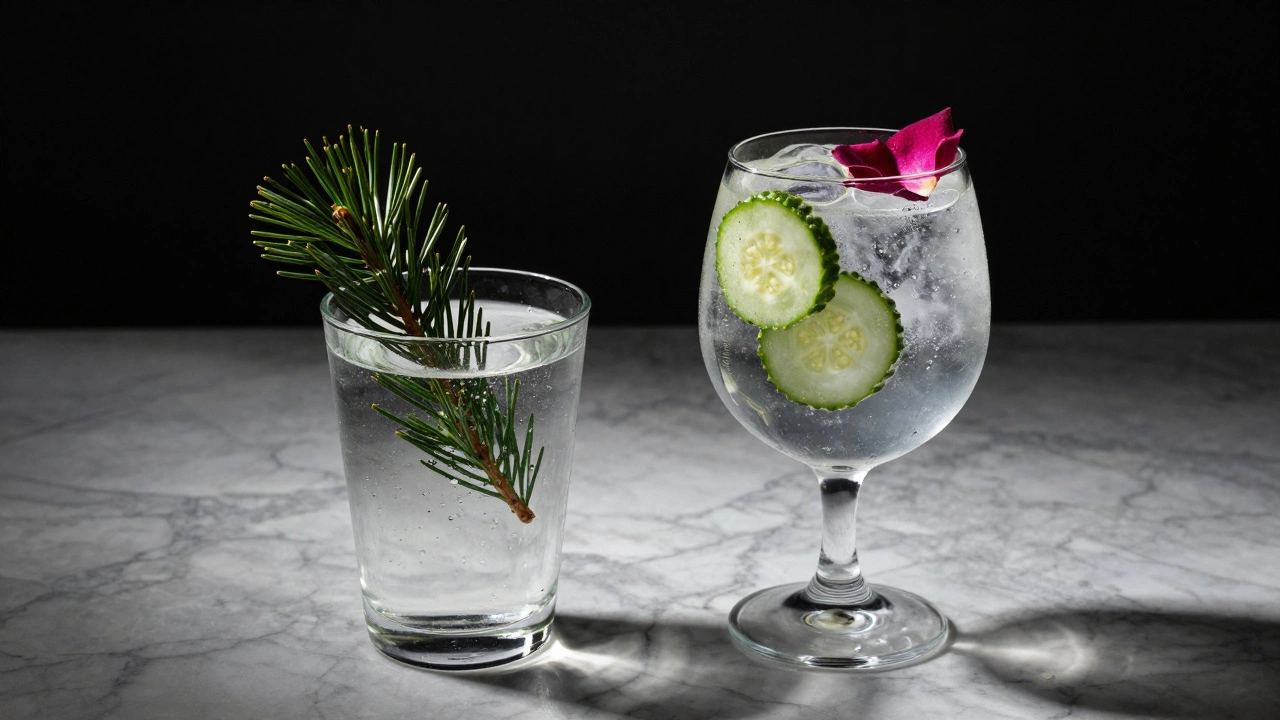
That cucumber? It’s not just for show. It’s part of what makes Hendrick’s a favorite for gin and tonics. Unlike Tanqueray, Hendrick’s blends seamlessly with tonic water. It doesn’t fight it. Instead, it complements it. Add a slice of cucumber to the glass, and you’ve got a drink that’s cool, crisp, and easy to sip all afternoon. It’s the kind of gin that turns people who say "I don’t like gin" into believers.
Flavor Battle: Juniper vs. Floral
Let’s cut to the chase. Tanqueray is all about juniper. It’s the star. Everything else supports it. Hendrick’s? Juniper is just one of eleven botanicals. It’s not even the loudest voice. Rose petals and cucumber are the headline act. The result? Two completely different experiences.
- Tanqueray: Sharp, piney, spicy, bitter. Think forest floor after rain, with a kick of citrus zest.
- Hendrick’s: Delicate, herbal, slightly sweet, with a cooling finish. Think a garden in the morning-roses, cucumber vines, and a breeze.
One taster described Tanqueray as smelling like a Sharpie marker. Another said Hendrick’s tasted like "alcoholic almond water." Those aren’t marketing slogans-they’re real tasting notes. And they’re both right.
Which One Should You Choose?
It’s not about which is "better." It’s about what you’re drinking and who you’re drinking with.
If you’re making a Negroni, Old Fashioned, or Martini-go with Tanqueray. It’s got the backbone. It doesn’t get lost. It’s the muscle in the mix.
If you’re sipping a gin and tonic on a warm afternoon, or you want something that feels refreshing rather than intense-Hendrick’s is your pick. It’s the kind of gin that invites you to slow down. It’s perfect for people who find traditional gin too harsh.
And if you’re mixing a gimlet? Both work. But Hendrick’s has a slight edge. It’s more forgiving. It doesn’t overpower lime or simple syrup. Tanqueray can work, but it needs more balance.
Market Presence and Perception
Tanqueray sold 4.5 million cases globally in 2019. That’s third in the world. It’s everywhere: bars, liquor stores, supermarkets. It’s the gin your dad drinks. It’s the gin you find in a well-stocked home bar from the 1980s.
Hendrick’s sold 1.4 million cases the same year. It’s not as big, but it’s everywhere you wouldn’t expect it. Boutique bars. Instagram feeds. Hotels with fancy ice cubes. Its packaging-with the vintage bottle and the floating cucumber-is impossible to ignore. It’s not just a gin. It’s a statement.
Tanqueray says: "This is what gin should be." Hendrick’s says: "What if gin was something else?"
Final Verdict: It’s Not About Right or Wrong
There’s no single answer. The difference between Tanqueray and Hendrick’s isn’t just in the bottle-it’s in your palate. If you grew up with gin as a bold, juniper-heavy spirit, Tanqueray will feel like home. If you’ve been turned off by that classic taste, Hendrick’s might be your gateway back.
Most serious bars keep both. Why? Because they serve different people. Different moods. Different drinks. One isn’t better. One isn’t outdated. They’re just different tools for different jobs.
Try them side by side. Pour a shot of each. Smell them. Sip them neat. Then mix each into a gin and tonic. Notice how one makes you sit up straight and the other makes you lean back. That’s the magic.
Is Hendrick’s really a London Dry gin?
No, Hendrick’s is not a London Dry gin. While it contains juniper and other traditional botanicals, it adds cucumber and rose petal essence after distillation. London Dry regulations require all flavors to be derived during distillation, so Hendrick’s technically falls outside the category-despite being called "gin" by most consumers.
Why does Tanqueray taste so strong?
Tanqueray is bottled at 94.6 proof (47.3% ABV), which gives it a powerful alcohol presence. Its flavor profile is intentionally bold and juniper-heavy to stand up in cocktails like the Negroni or Martini. The high proof ensures the gin doesn’t get lost when mixed with strong ingredients like vermouth or bitters.
Can I use Hendrick’s in a Negroni?
Yes, you can-but it’s not ideal. Hendrick’s floral and cucumber notes can clash with the bitter Campari and sweet vermouth, making the drink feel unbalanced. Tanqueray is the classic choice for Negronis because its strong juniper flavor holds its own. If you want to experiment, try Hendrick’s in a lighter variation with less vermouth.
Which gin is better for beginners?
Hendrick’s is usually better for beginners. Its floral, cucumber-forward profile is less intense than Tanqueray’s sharp juniper. Many people who say they don’t like gin find Hendrick’s surprisingly approachable-especially in a gin and tonic with a cucumber slice.
Do I need both in my home bar?
If you mix cocktails often, yes. Tanqueray handles classic, bold drinks. Hendrick’s shines in light, refreshing cocktails and gin tonics. Having both gives you flexibility. You’ll use Tanqueray for winter drinks and Hendrick’s for summer sipping. They’re not interchangeable-they’re complementary.
If you’ve only ever tried one of these gins, you haven’t really tried gin. Try both. Then decide.