Wine Tip Calculator
Calculate Your Wine Tip
This tool helps you determine the appropriate tip for expensive wine based on service context and restaurant type.
Ever sat down for a fancy dinner, ordered a $600 bottle of wine, and frozen when the bill came? You’re not alone. The question of whether to tip 20% on expensive wine isn’t just about money-it’s about respect, fairness, and not overpaying for service that’s already been paid for in other ways.
Why This Question Even Exists
Tipping on wine isn’t like tipping on a burger and fries. When you order a $1,200 bottle of Bordeaux, you’re not just paying for the liquid in the bottle. You’re paying for decades of farming, aging, bottling, shipping, and the sommelier who hand-selected it. But here’s the thing: the staff serving it? They’re not getting a cut of the wine’s markup. Most restaurants make money on wine, but the server? They’re paid hourly, often minimum wage or slightly above, and rely on tips to make ends meet.So if you tip 20% on a $600 bottle, that’s $120. Is that fair? Or is it excessive? The answer isn’t one-size-fits-all. It depends on where you are, what kind of service you got, and how the restaurant handles tips.
Restaurant Settings: The Default Rule (and When to Break It)
In most U.S. restaurants, the standard is 15-20% of the total bill. That includes food, drinks, and wine. But here’s what most people don’t realize: when wine makes up more than half the bill, many regular fine diners adjust downward. A 2022 OpenTable survey found that only 12% of diners actually calculate 20% on the wine portion alone. Most just stick with 15-20% on the total.Why? Because tipping 20% on a $500 wine feels like paying for the wine’s prestige, not the service. A sommelier who spent 15 minutes helping you pick a bottle, pairing it with your food, and pouring it perfectly? That’s worth more than a flat percentage. But if they just brought you the bottle and left? That’s service, not expertise.
Industry insiders have a rule of thumb: if wine is over 60% of your bill, drop the tip percentage to 15%. That’s not stingy-it’s smart. You’re still giving 15% of a $1,000 total bill, which is $150. That’s more than enough for great service. And if the sommelier went above and beyond? Add $20-$50 in cash. Cash tips go directly to the staff. Credit card tips? Often get split, taxed, or even siphoned off by management.
Winery Tastings: It’s Not About the Price of the Wine
At a Napa Valley winery, you might pay $75 per person for a tasting of five rare bottles. One of them costs $800. Should you tip 20% of that? No.Winery tasting staff aren’t paid the same way as restaurant servers. Many earn $16-$18/hour plus tips, but they don’t get a cut of wine sales. They get paid by the winery, not the bottle. So tipping based on bottle price doesn’t make sense. Instead, the standard is $10-$20 per couple, regardless of how expensive the wines were.
Here’s the truth: if you’re tasting $500 bottles, you’re probably already spending $200-$500 on wine to take home. That purchase? That’s your tip. The tasting fee covers the experience. The tip? It’s for the person who explained the terroir, poured each glass with care, and remembered your name.
And if you’re on a 2-for-1 tasting pass? Still tip. Just because you didn’t pay full price doesn’t mean the staff didn’t work just as hard. Napa Valley Tourist Guide says flat-out: “Tipping is still expected.”

Retail Wine Purchases: Don’t Tip Unless They Went Above and Beyond
Buying a case of $200-a-bottle wine at a specialty shop? You’re not obligated to tip. Not at all.Wine Spectator’s Dr. Vinny says it plainly: “I don’t think you should feel obligated to make your tip proportional to the price of the case-or even to tip at all.”
But here’s the exception: if the clerk spent 45 minutes helping you pick out a gift for a wedding, explained aging potential, and even offered to store it for you? That’s service. A flat $10-$20 tip in cash is perfect. Cash again, because retail shops often pool tips and distribute them unevenly. A cash tip? It goes straight to the person who helped you.
And if you’re just walking in, grabbing a bottle, and leaving? Skip it. No one expects it.
European vs. American Tipping: Two Different Worlds
If you’re in Italy, Spain, or France, tipping on wine is completely different. In Spain, you might leave €5 if the service was good. In Italy, €5-€10 is common. In France? Sometimes a 10% service charge is already included. You don’t tip because the system assumes you’ve paid for service.Why? Because European hospitality workers earn minimum wages of €1,230/month or more. They’re not relying on tips to survive. In the U.S., federal tipped minimum wage has been $2.13/hour since 1991. Even in states with higher wages, tips are still essential. That’s why American servers expect 15-20%. In Europe? They don’t.
So if you’re traveling? Adjust. Tipping 20% in Paris? You’ll look like a tourist. Tipping €10? You’ll look like someone who knows what they’re doing.
What the Experts Say
Sommelier Michael Madrigale (President of the Sommelier Association of America) has a clear breakdown:- Wine under $300? Tip 15-20% on total bill.
- Wine between $300-$600? Tip 15%.
- Wine over $600? Tip a flat $50-$100.
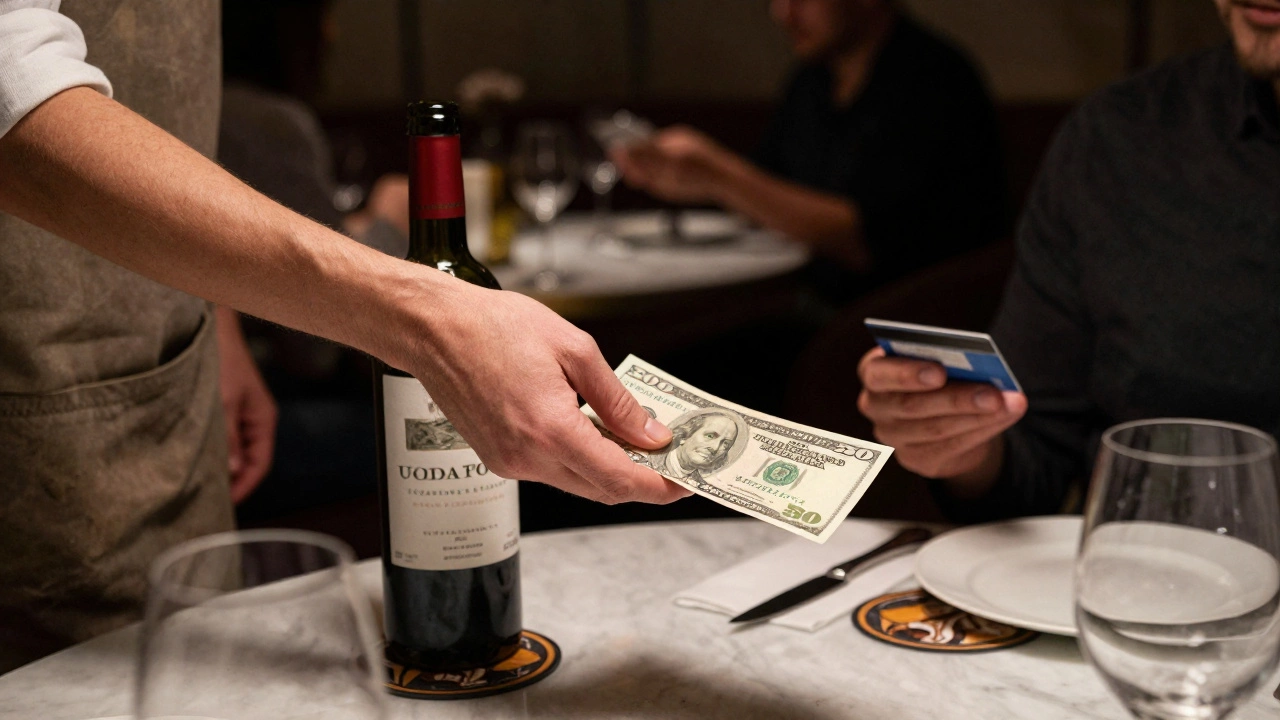
That’s not arbitrary. It’s designed to reward skill without forcing people into financial strain. And it matches what staff actually prefer. One sommelier on Reddit, with 8 years of fine dining experience, said: “When someone orders a $1,000+ bottle, we actually prefer $50 cash in hand over 20% on the credit card slip because management often keeps card tips.”
And that’s the key insight: cash tips matter. Credit card tips? They’re often subject to payroll deductions, pooled into tip jars, or even partially kept by the restaurant. A $100 cash tip? That’s $100 in the server’s pocket. A $100 credit card tip? Maybe $70 after fees and management shares.
What Not to Do
Don’t tip 20% on a $1,000 bottle just because you think it’s expected. That’s not generosity-it’s performance anxiety.Don’t skip tipping because the wine was expensive. That’s not frugal-it’s disrespectful.
Don’t assume the sommelier gets a cut of the wine sale. They don’t. They get paid hourly. Their income comes from your tip, not your purchase.
Don’t tip based on wine price alone. Tip based on service.
The Bottom Line
You don’t tip 20% on expensive wine because it’s expensive. You tip because someone made your experience better.Here’s your simple guide:
- Restaurant: Tip 15% on total bill if wine is over half the cost. Add $20-$50 cash if the sommelier earned it.
- Winery tasting: Tip $10-$20 per couple. Doesn’t matter if you tasted a $10,000 bottle.
- Wine shop: Tip only if they went above and beyond. $10-$20 cash is plenty.
- Europe: €5-€10 flat. If service charge is included, skip it.
And remember: cash is king. If you want the person who poured your wine to actually benefit from your generosity? Hand it to them. No receipt. No middleman. Just a simple thank you-and a few bucks in their hand.
Should I tip 20% on a $1,000 bottle of wine?
No, you shouldn’t automatically tip 20% on a $1,000 bottle. That’s $200-and most of it won’t even go to the server. Instead, tip 15% on the total bill (which might still be $150), then add $50-$100 in cash if the sommelier gave you exceptional service. Cash tips go directly to staff, while credit card tips often get split or taken by management.
Is it rude not to tip on expensive wine?
It’s not rude if you follow the context. If you’re at a high-end restaurant and skip tipping entirely, yes-that’s rude. But if you tip 15% on a $1,200 bill (which includes $800 in wine), you’re being fair. Tipping isn’t about the price of the wine. It’s about the service. If the staff did their job, a fair tip is expected. If they went above and beyond, go a little higher.
Do winery tasting staff expect tips?
Yes. Even if you’re on a discount or free tasting pass, staff are still working. They poured wines, answered questions, and made your visit enjoyable. The standard is $10-$20 per couple. It doesn’t matter if the wine cost $100 or $1,000 per bottle-your tip should reflect the service, not the price.
Why do some people say to tip in cash?
Because cash tips go directly to the person who served you. Credit card tips often get pooled, taxed, or partially kept by the restaurant. In some places, management takes a cut before distributing tips. A $50 cash tip? That’s $50 in the server’s pocket. A $50 card tip? Maybe $35 after fees and management fees. Cash is the only way to guarantee your generosity reaches the right person.
What if I’m on a budget but still want to tip fairly?
You don’t need to break the bank. Tip 15% on the total bill-even if wine is expensive. If you can’t afford more, that’s still fair. Many servers say they’d rather get a consistent 15% from everyone than a huge tip from one person and nothing from others. Your tip, no matter the size, helps someone make a living. A $20 tip on a $150 bill is better than nothing.