Global Drink Market Share Calculator
How Your Drink Habits Compare to the World
Learn how your personal drink consumption compares to global market statistics. The article explains that bottled water makes up 38.7% of all non-alcoholic drink volume worldwide, while carbonated soft drinks account for 32.1%.
Your Consumption Analysis
Your total daily consumption: 0.0 liters
Water: 0% of your consumption
Soda: 0% of your consumption
Other: 0% of your consumption
Global Market Context
Bottled water makes up 38.7% of all non-alcoholic drink volume worldwide. Carbonated soft drinks account for 32.1%.
You are drinking 0% of your total water consumption compared to the global average.
You are drinking 0% of your total soda consumption compared to the global average.
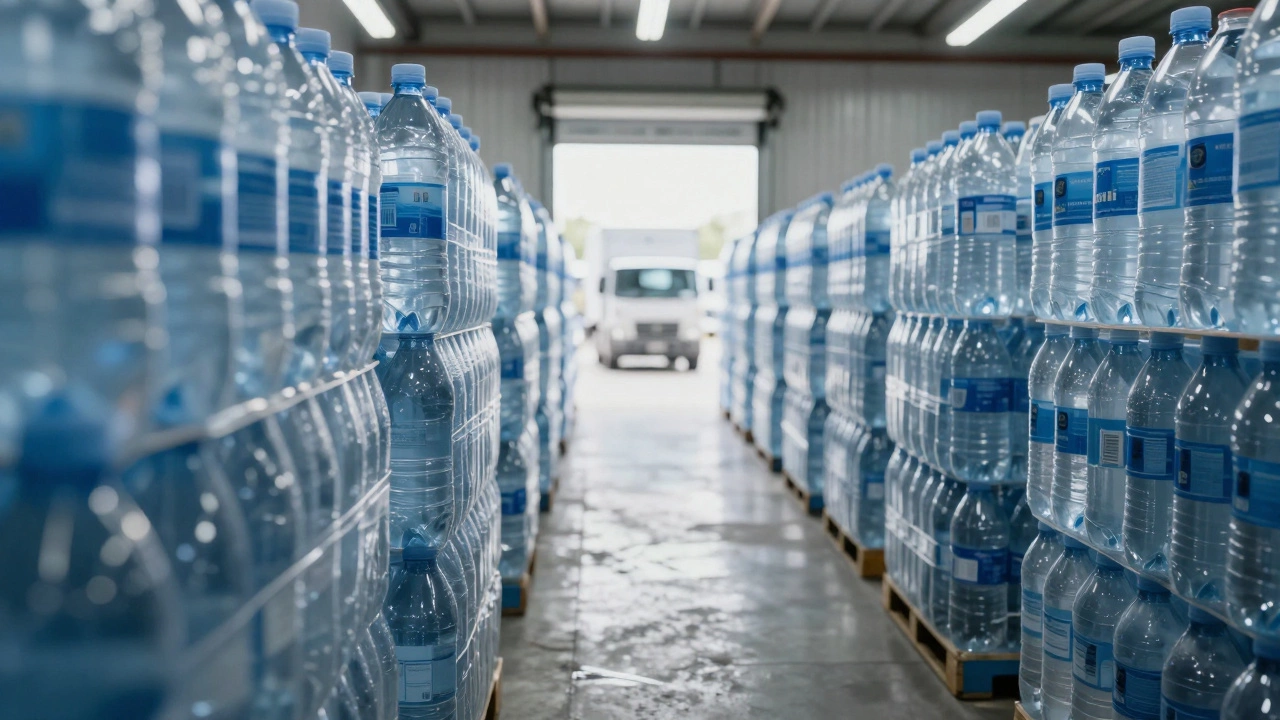
When you think of the world’s most popular non-alcoholic drink, you might picture a fizzy cola, a cold bottle of water, or maybe a trendy herbal sip. But here’s the real answer: bottled water is the most consumed non-alcoholic drink on the planet - not by brand, not by hype, but by sheer volume.
Back in 2023, global bottled water consumption hit 422.6 billion liters. That’s more than all the soda, juice, energy drinks, and coffee combined. By 2027, that number is expected to climb past 478 billion liters. Why? Because people are drinking more water than ever before. It’s simple, it’s cheap, and it’s everywhere.
Now, if you’re thinking, "But what about Coca-Cola?" - you’re not wrong. Coca-Cola is the most recognized beverage brand on Earth. Nine out of ten people globally know the logo, the red-and-white label, the taste. The company reports that 2.2 billion servings of Coca-Cola are consumed every single day. That’s more than the population of India. But here’s the key difference: Coca-Cola is a brand. Bottled water is a category. And when you add up every brand of bottled water - Aquafina, Dasani, Evian, Fiji, local spring water, even tap water sold in plastic - it dwarfs any single soft drink.
Let’s break it down. In 2024, bottled water made up 38.7% of all non-alcoholic drink volume sold worldwide. Carbonated soft drinks like Coca-Cola and Pepsi came in second at 32.1%. That gap isn’t small. It’s the difference between a marathon and a sprint. Water wins because it’s not just a drink - it’s a necessity. People drink water to hydrate. They drink soda to enjoy. One is routine. The other is a treat.
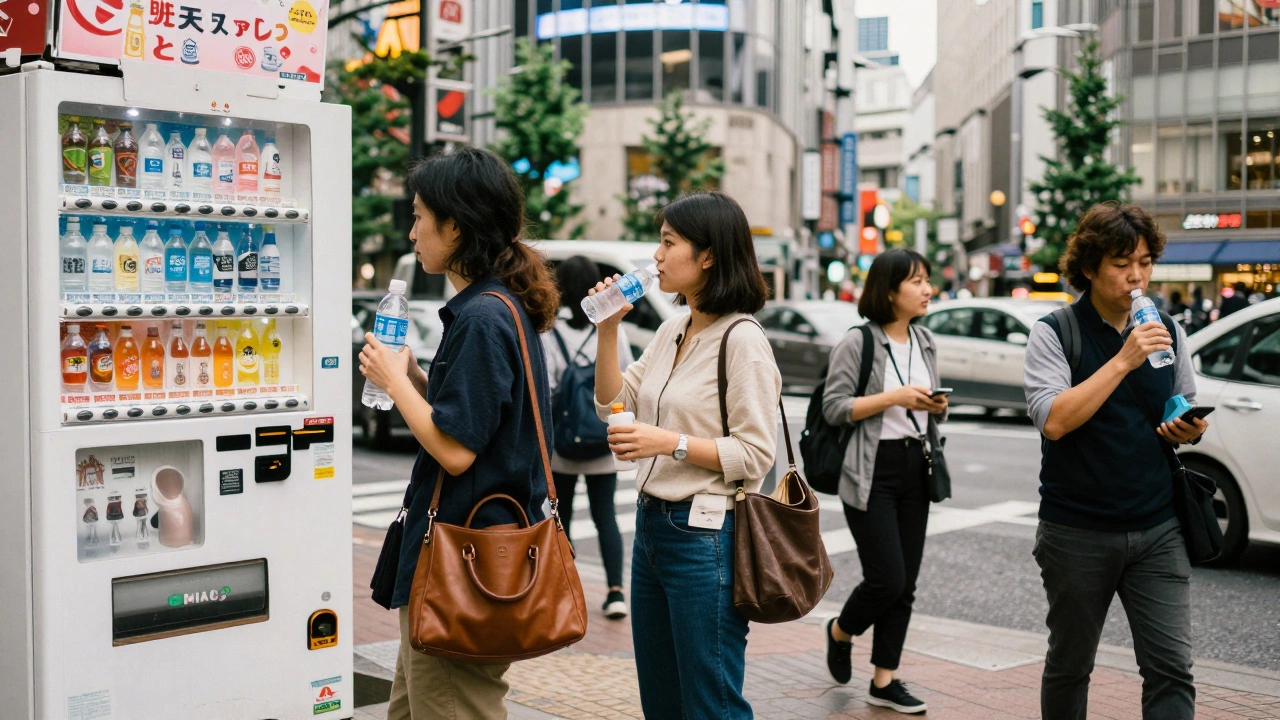
And it’s not just about health. Access matters. In rural parts of India, Nigeria, or Indonesia, bottled water is often the safest option. In cities like Tokyo, Berlin, or Sydney, it’s about convenience. You grab a bottle on your way to work. You refill at the gym. You carry it in your bag. It’s not a choice - it’s part of daily life.
Meanwhile, Coca-Cola’s dominance is real, but it’s slowing. Sales of carbonated soft drinks grew just 1.2% in 2024. Bottled water? Up 4.7%. Why? Sugar taxes. Health warnings. Rising awareness. The American Heart Association says adults should consume less than 25 grams of added sugar per day. One 12-ounce can of Coca-Cola has 39 grams. That’s more than a full day’s limit in one sip. No wonder people are switching.
But here’s something interesting: even though water leads in volume, Coca-Cola still wins in cultural presence. It’s in movies, ads, sports events, street corners in every country. You can buy a Coke in a village with no running water. You can’t always buy bottled water in the same place. Coca-Cola’s distribution network is unmatched. It’s in 200+ countries. It’s on every shelf. It’s been around since 1886. That kind of loyalty doesn’t fade overnight.
And then there’s the new wave - non-alcoholic spirits, adaptogen drinks, zero-proof tonics. Brands like Ritual Zero Proof, Ghia, and Seedlip are growing fast. They’re marketed to people who want to quit alcohol but still crave complexity. They’re sold in fancy bars, sold online, sold for $38 a bottle. But here’s the truth: in 2025, the entire non-alcoholic spirits market was still under $3 billion. Bottled water? Over $100 billion. The new stuff is exciting. It’s trendy. But it’s still a drop in the ocean.
What about taste? People love Coca-Cola for its balance - sweet, fizzy, familiar. But they love water because it’s neutral. It doesn’t fight you. It doesn’t make you feel sluggish. It doesn’t come with a sugar crash. It just works.
Some say bottled water is boring. Others say it’s genius. The data doesn’t care. It shows the same thing year after year: more people are drinking more water than any other beverage. Even in places where tap water is safe, people still buy bottled. Why? Trust. Convenience. Habit.
So who’s the most popular non-alcoholic drink? If you’re counting bottles, it’s bottled water. If you’re counting brand recognition, it’s Coca-Cola. But if you’re asking what people drink every day, without thinking - it’s water. Plain, simple, and everywhere.
Why Bottled Water Beats Everything Else
It’s not glamorous. It doesn’t have a flavor profile. It doesn’t come in limited-edition cans. But bottled water is the ultimate utility drink. Here’s why it dominates:
- No calories, no sugar, no additives - unlike soda, juice, or energy drinks, water has zero nutritional baggage.
- Universal availability - 98% of global retail locations stock bottled water. Fewer than 70% stock energy drinks. Only 45% carry non-alcoholic spirits.
- Price point - a 500ml bottle costs as little as $0.20 in bulk. A can of soda? $0.50-$1.00. A bottle of Ritual Zero Proof? $3.85 per serving.
- Health alignment - global health organizations all recommend water as the primary daily fluid. No debate.
- Climate and infrastructure - in places with unreliable tap water, bottled water is the only safe option. Even in wealthy countries, people prefer it for perceived purity.
How Coca-Cola Stays on Top - Even as Water Rises
Coca-Cola didn’t become the world’s most recognized brand by accident. It’s a machine. Here’s how it holds on:
- Brand loyalty - 94% of people globally recognize the Coca-Cola logo. That’s higher than McDonald’s or Apple.
- Global reach - it’s sold in every country, from Manhattan to Malawi. No other soft drink comes close.
- Marketing muscle - Coca-Cola spends over $4 billion a year on advertising. That’s more than the entire non-alcoholic spirits category combined.
- Product evolution - Coca-Cola launched "Coca-Cola Clear" in early 2025: colorless, 30% less sugar, zero calories. It’s not replacing the original - it’s expanding the audience.
- Partnerships - from the Olympics to FIFA, Coca-Cola owns major events. It’s not just a drink - it’s part of the experience.
But here’s the catch: Coca-Cola’s volume growth is flat. Water is rising. People are cutting back. And the company knows it. That’s why they’re investing in water brands like Dasani and Smartwater. They’re not just selling cola anymore - they’re selling hydration.
The Rise of the Sober-Curious: Are Premium NA Drinks the Future?
There’s a quiet revolution happening. More people are cutting back on alcohol. A February 2025 poll found 38% of U.S. adults are moderating their intake. Enter non-alcoholic spirits.
Brands like Ghia, Little Saints, and Ritual Zero Proof are booming. They’re marketed as "craft," "functional," "adaptogenic." Some contain lion’s mane. Others have CBD. A few claim to reduce stress. They’re sold in upscale liquor stores, not soda aisles. And they’re expensive - often 3 to 4 times the price of a regular cocktail.
But here’s the reality: even with 16.3% annual growth, this segment is still tiny. In 2025, it accounted for less than 0.2% of the total non-alcoholic drink market. Most consumers try one or two brands, then stop. Why? Price. Confusion. Lack of availability. And skepticism.
Dr. Emily Chen from Harvard’s School of Public Health put it bluntly in early 2025: "Many adaptogen claims lack robust clinical evidence for the doses present in these beverages." In other words: you’re paying for a feeling, not a proven benefit.
Still, the trend is real. Younger consumers - especially those aged 25-34 - are driving this shift. Social media is full of #SoberCurious posts. Bars are adding NA options. Companies like Diageo are buying up these brands. But don’t confuse trend with dominance. This isn’t replacing water. It’s not even replacing soda. It’s a niche. A growing one. But still a niche.
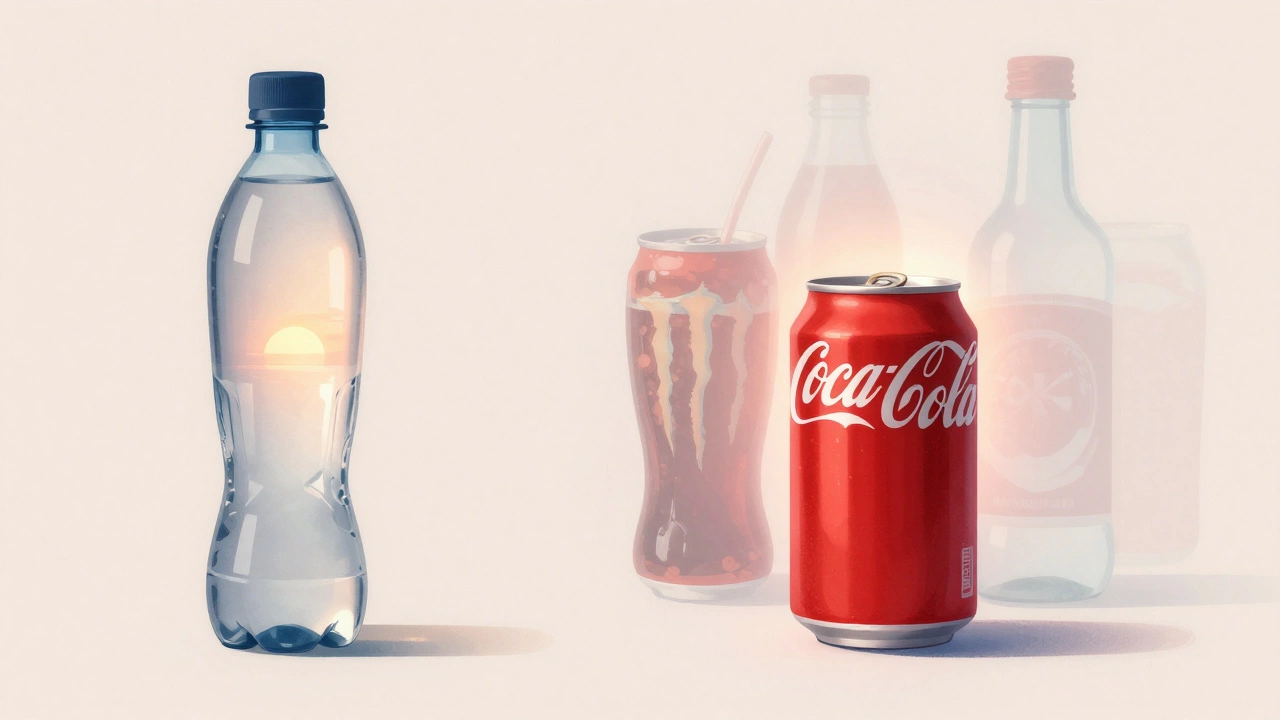
What You’re Really Drinking - And Why It Matters
Let’s get personal. What’s in your fridge? Your lunchbox? Your desk at work?
If it’s a bottle of water - you’re part of the majority. You’re drinking the most common non-alcoholic beverage on the planet. No judgment. Just facts.
If it’s a soda - you’re part of a huge, loyal crowd. But you’re also part of a group that’s slowly shrinking as health awareness rises.
If it’s a fancy zero-proof tonic - you’re part of the future. But you’re also paying a premium for something most people still don’t understand - or need.
The truth? Most people don’t drink for flavor. They drink for function. Water hydrates. Soda satisfies. NA spirits impress. But only one of them is essential.
What’s Next for Non-Alcoholic Drinks?
The future isn’t about replacing water or soda. It’s about layering choices.
- Water will keep growing - especially in developing nations and urban centers.
- Soda will shrink, but not disappear. Brands will keep reformulating - less sugar, more flavor, more innovation.
- NA spirits will grow - but only if they solve the price and perception problem. They need to prove they’re worth more than a gimmick.
- Functional drinks - with probiotics, electrolytes, vitamins - will gain ground. Especially among athletes, travelers, and older adults.
One thing’s certain: the market won’t settle on one winner. It will keep evolving. But the leader? That’s not changing.